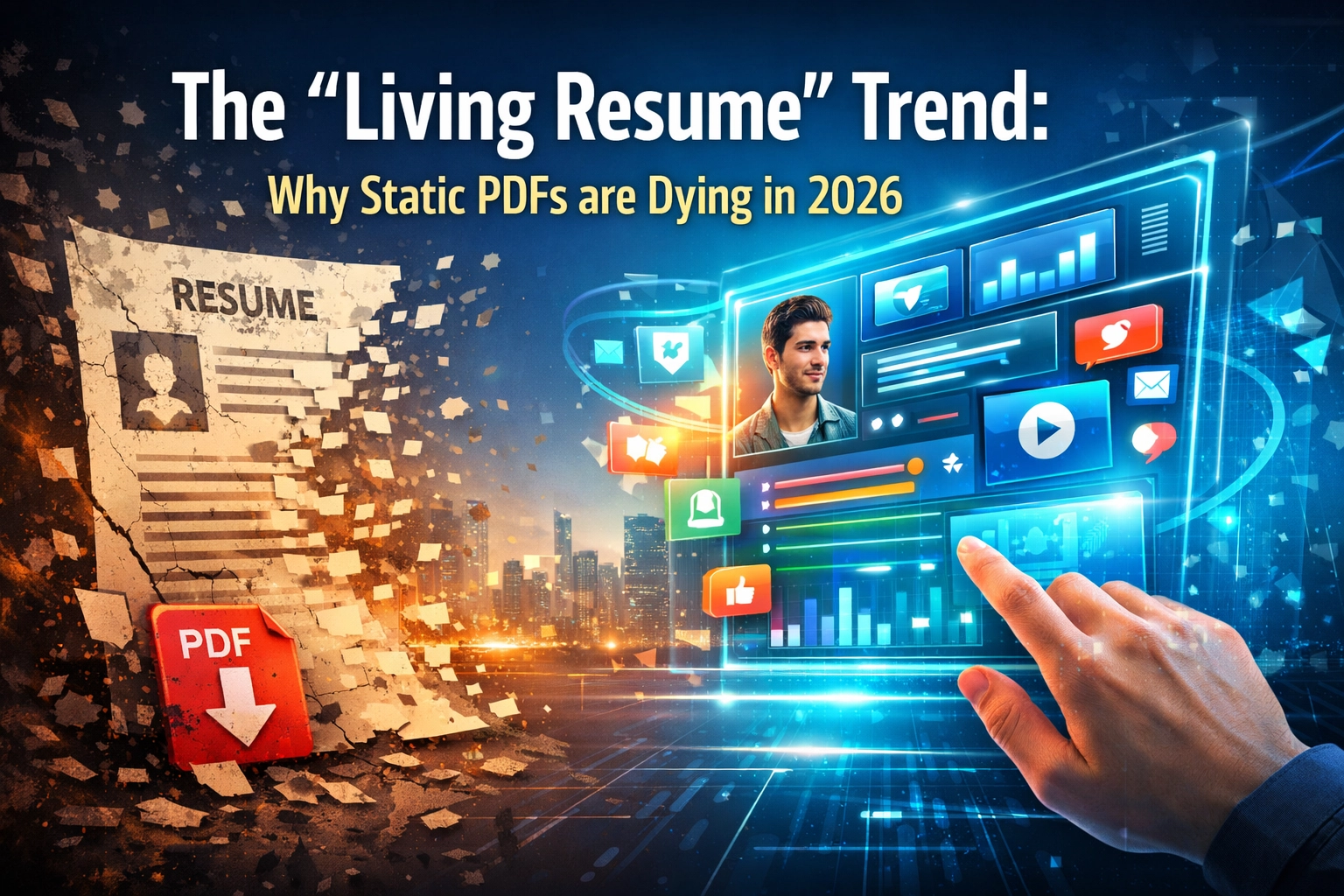
For over three decades, the Portable Document Format (PDF) has been the gold standard for job applications. It was reliable, unchangeable, and professional. But as we navigate the first quarter of 2026, the static PDF is no longer a tool of empowerment; it’s a bottleneck. In a high-velocity job market driven by Generative Engine Optimization (GEO) and Agentic AI, a document that stays the same from the moment you hit "Save" to the moment a recruiter opens it is effectively obsolete.
The shift we are seeing today is toward the "Living Resume." This isn't just a digital version of your CV; it is a dynamic, interconnected, and real-time data profile that evolves as you do. If you are still sending out static attachments and wondering why you aren't getting pings from top-tier tech firms, you are likely falling victim to the limitations of 1990s technology in a 2026 world.
The Technical Decay of the Static PDF
To understand why the PDF is dying, we have to look at how hiring actually happens in 2026. Recruitment is no longer a human-first process. It is an AI-agent-first process.
Modern Applicant Tracking Systems (ATS) have evolved into "Recruitment Intelligence Engines." These engines don't just "read" your resume; they cross-reference the claims in your resume against the live web. When an AI recruiter parses a static PDF, it treats the data as "stale."
1. The Metadata Problem
PDFs are notoriously bad at carrying verified metadata. A Living Resume: often hosted on a personal domain or a specialized platform: uses structured data (JSON-LD) to tell AI search engines and internal HR tools exactly what your skills are, where you learned them, and how they’ve been validated.
2. Lack of Version Control
In 2026, skills have a shorter half-life than ever. If you completed a certification in "Agentic Workflow Automation" last Tuesday, your PDF from last Monday is already inaccurate. A Living Resume updates automatically via API hooks to your learning platforms (like Coursera or edX) and your project repositories (like GitHub).
What Exactly is a "Living Resume"?
A Living Resume is a centralized, digital "Source of Truth" for your professional identity. It is characterized by three core pillars: Real-time Integration, Verified Proof, and Interactive Discovery.
Real-Time Integration
Instead of manual updates, a Living Resume pulls data from your active professional nodes.
- GitHub/GitLab: For developers, your "resume" displays your most recent commits and the languages you are currently mastering.
- Figma/Dribbble: For designers, it showcases your latest live prototypes.
- LMS Platforms: Your credentials from IIM, Google, or specialized AI ethics boards are pushed to your profile the moment you pass the exam.
Verified Proof (The End of "Resume Padding")
We’ve all seen the era of "AI Prompt Engineer" appearing on every resume in 2024. By 2026, recruiters are exhausted by unverified claims. A Living Resume utilizes blockchain-backed micro-credentials. When you list a skill, the "Living" aspect allows a recruiter to click a badge and see the cryptographic proof of your competency. This transparency is what earns the "Highly Qualified" tag in modern ATS filters.
Interactive Discovery
A static PDF is a monologue. A Living Resume is a conversation. In 2026, recruiters want to see how you think. Living resumes often include embedded video "explainer" snippets for specific projects or interactive "Skill Maps" that show the depth of your expertise in various tech stacks.
The Role of GEO (Generative Engine Optimization)
The death of the PDF is closely linked to the rise of GEO. Just as we used to optimize websites for Google Search (SEO), professionals in 2026 must optimize their careers for Generative Engines.
When a CEO or a Hiring Manager asks their AI assistant, "Find me the best Cloud Architect in Johannesburg who specializes in sustainable data centers," the AI doesn't go looking through a folder of downloaded PDFs. It crawls the live web. It looks for structured profiles, active contributions, and verified digital footprints.
If your professional history is trapped inside a static file on a recruiter’s hard drive, you don’t exist to the generative engines. A Living Resume provides the indexable content these engines need to recommend you as a top candidate.

Data-Driven Insights: Why Employers Prefer Dynamic Profiles
The data from the first half of the 2020s showed a clear trend. According to recent 2025-2026 industry surveys, companies that transitioned to "Skills-Based Hiring" saw a 35% increase in high-performer retention.
For an employer, a Living Resume reduces the "Risk of the Unknown."
- Reduced Time-to-Hire: AI agents can verify a candidate’s entire history in seconds if the data is structured and live.
- Accurate Skill Mapping: Managers can see the progression of a candidate’s learning path, indicating "Learning Agility": the most sought-after soft skill of 2026.
| Feature | Static PDF Resume | Living Resume (2026) |
|---|---|---|
| Update Frequency | Manual/Occasional | Real-time/Automated |
| Verification | Trust-based (Manual) | Cryptographic/API-based |
| Searchability | Low (Internal only) | High (GEO-optimized) |
| Rich Media | Text/Images only | Video, Live Code, Interactive Data |
| AI Compatibility | Optical Character Recognition | Semantic Structured Data |
How to Build Your Living Resume Today
You don't need to be a software engineer to ditch the PDF. Here is the roadmap to creating a professional identity that survives the 2026 market.
1. Move to a Personal Hub
Platforms like Notion, Read.cv, or even a custom-built Next.js site are the new standards. Your resume should live at yourname.com or a dedicated professional URL. This ensures that you own the data and the "source of truth."
2. Implement "Stackable" Credentials
Stop listing "Education" as a single block at the bottom. Use dynamic widgets that pull from your LinkedIn Learning, Coursera, or professional certification bodies. In 2026, the recency of your learning is often more important than your degree from a decade ago.
3. Shift from "Tasks" to "Impact Data"
Static resumes usually say: "Managed a team of 10."
A Living Resume shows: "Currently managing a team of 10 with a live productivity score of X, utilizing Agentic AI tools to reduce operational overhead by 22% this quarter."
4. Optimize for "Agentic Crawlers"
Ensure your digital profile uses clear headings and schema markup. Use the terminology that 2026 AI recruiters look for: Cross-functional AI orchestration, Ethical AI compliance, GEO-strategy, and Neural-linguistic mapping.
The "Human" Element: Is Personality Lost?
A common fear is that by moving to data-driven, Living Resumes, we lose the "soul" of the candidate. The opposite is actually true.
Because the "Living" format allows for rich media, candidates are finally able to showcase their personality without the constraints of a one-page A4 layout. Video introductions, links to thought-leadership podcasts, and interactive "Work Philosophy" sections allow a recruiter to feel like they know you before the first interview.
In 2026, the interview is no longer about "What have you done?" (the Living Resume already answered that). The interview is now about "How do you fit our culture?"
Final Thoughts: Adapt or Be Filtered Out
The transition from static PDFs to Living Resumes is not just a trend; it is a fundamental shift in the infrastructure of the global labor market. We are moving from a world of declarations to a world of demonstrations.
If you want to stay relevant, you must treat your professional profile as a living organism. It needs to be fed with new data, optimized for the latest AI agents, and accessible to the world 24/7. The "Living Resume" is your ticket to the top 1% of the 2026 workforce.
About the Author: Malibongwe Gcwabaza
CEO, blog and youtube
Malibongwe Gcwabaza is a visionary leader in the digital education and career development space. With over a decade of experience navigating the intersection of technology and human capital, Malibongwe has helped thousands of professionals pivot into high-growth tech careers. As the CEO of blog and youtube, he focuses on demystifying complex AI trends and providing actionable roadmaps for the modern workforce. He believes that in the age of AI, "The greatest skill is not knowing the answer, but knowing how to evolve."
About the Author