We’ve all been there. You sign up for a massive online course, ready to change your life. You open the first module and see a video that is 58 minutes long. Suddenly, checking your email or organizing your sock drawer seems like a much better use of time. It’s not that you’re lazy; it’s that your brain is literally wired to resist that kind of information dump.
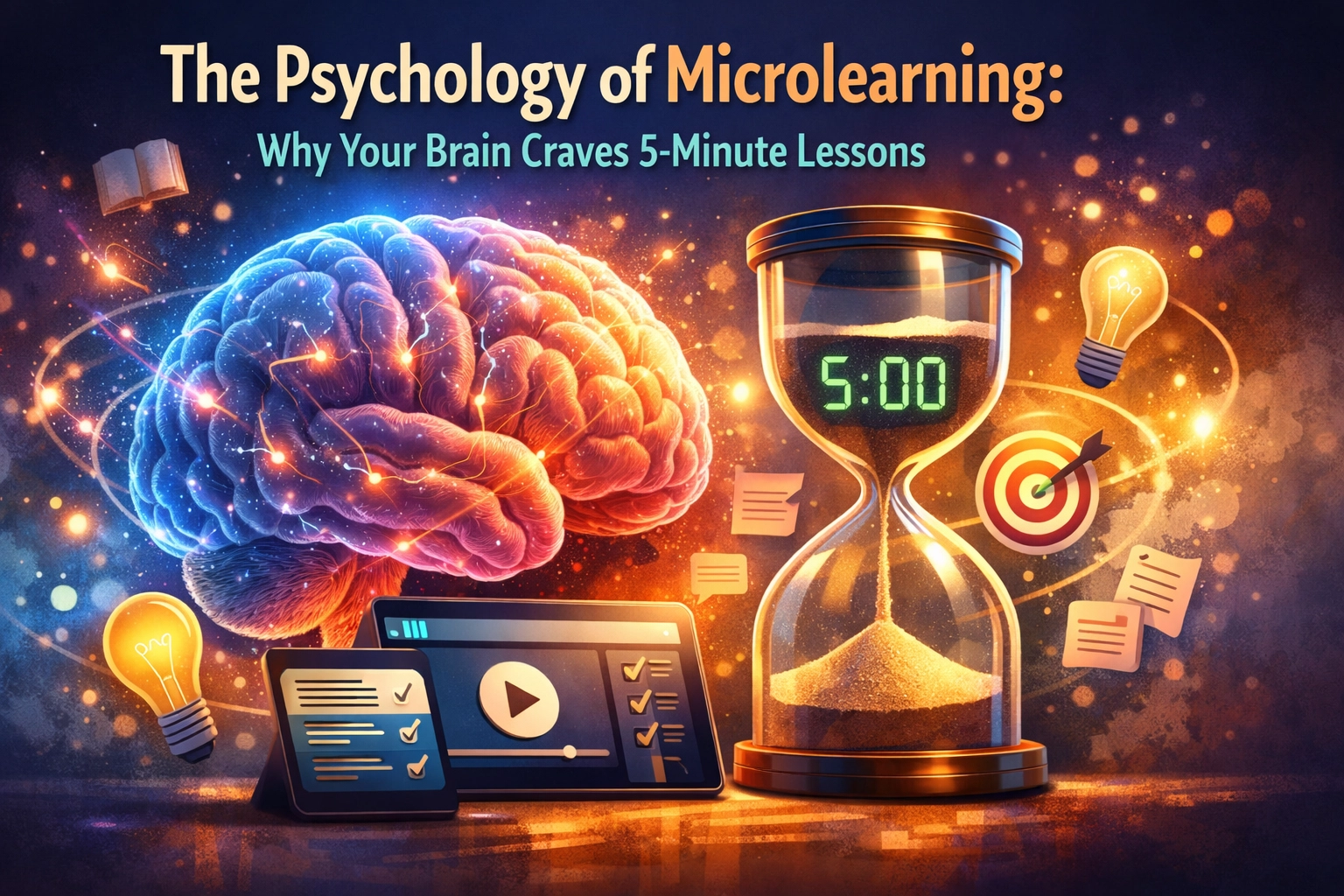
At Learnrise, we’re obsessed with how people actually learn, not just how we wish they learned. The reality is that our brains aren’t hard drives where you can just drag and drop a 2GB file of "Marketing Knowledge" and expect it to stick. Our brains are more like biological processors with a very specific, and surprisingly small, "RAM" capacity. This is where the psychology of microlearning comes in.
By breaking information down into five-minute chunks, we aren't just making things "easier": we are aligning with the way human biology processes data. If you’re looking at SEO strategies 2026 or building a content marketing plan for a small business, understanding this shift is the difference between a team that grows and a team that burns out.
The Glass is Full: Understanding Cognitive Load Theory
To understand why 5-minute lessons work, we have to talk about Cognitive Load Theory. Think of your working memory as a glass of water. Every piece of new information you try to learn is like pouring more water into that glass.
Your working memory is responsible for processing new information, but it has a very strict limit. Once the glass is full, any extra water you pour in just spills over the side and ends up on the floor. In learning terms, that "spilled water" is the information you forget ten minutes after the video ends.
Microlearning works because it never overflows the glass. By delivering one single concept at a time: one specific SEO tactic or one specific coding function: the brain has enough room to process it, move it into long-term storage, and then empty the glass for the next sip.

Why the "Small Win" is a Biological Cheat Code
There is a reason you can scroll through TikTok for an hour but struggle to watch a twenty-minute educational lecture. It’s the dopamine loop.
Every time you finish a small task: like a 5-minute lesson: your brain releases a tiny hit of dopamine. This is the "reward" chemical. In traditional learning, you don't get that reward until the end of a long, grueling module. By the time you get there, you’re too exhausted to enjoy it.
In microlearning, you get that reward every five minutes. This creates a psychological "momentum." Instead of feeling like you’re climbing a mountain, you feel like you’re hitting a series of green lights. This is a massive part of effective content marketing for small business owners: if you can give your audience quick, actionable wins, they will keep coming back for more because their brains are literally craving that next hit of accomplishment.
The Chemistry of Focus: Fighting Mental Fatigue
Have you ever noticed that after a long meeting, your brain feels like mush? That’s not just a feeling; it’s chemistry.
Extended mental effort triggers something called "central fatigue." When you focus intensely for long periods, your brain depletes its supply of specific neurotransmitters needed for cognitive performance. It’s like a car running out of gas. If you keep pushing, the engine starts to knock.
Microlearning preserves this neurochemical balance. Because the sessions are short, you stop before you hit the point of depletion. This allows the brain to maintain "steady-state" performance. Research shows that learners who use microlearning often finish entire courses faster than those in traditional formats, simply because they don't have to spend hours recovering from "brain fry" after every session.
Beating the Forgetting Curve with Spaced Repetition
Back in the 1880s, a psychologist named Hermann Ebbinghaus discovered the "Forgetting Curve." He found that humans lose about 70% of new information within 24 hours if they don't make an effort to retain it.

Microlearning is the natural enemy of the Forgetting Curve. Because the lessons are small, they are incredibly easy to repeat. This ties into "Spaced Repetition": the practice of reviewing information at increasing intervals.
Instead of sitting through a three-hour seminar on SEO strategies 2026 once a year, microlearning allows you to spend five minutes a week refreshing a specific concept. This constant "pinging" of the memory strengthens the neural pathways, making the information nearly impossible to forget. It’s the difference between building a sandcastle that gets washed away by the tide (cramming) and carving a statue out of stone (microlearning).
Microlearning as a Content Marketing Strategy for Small Business
If you’re running a small business, you probably don’t have a million-dollar budget for content. But you do have knowledge. The mistake most businesses make is trying to write the "definitive 50-page guide" to their industry. Nobody reads those.
If you want to win in content marketing for small business, you should be thinking in "micro" terms.
- The 2-minute "How-To" video.
- The 3-item checklist.
- The 5-minute industry update.
This isn't just better for your audience; it’s better for your SEO. In the landscape of SEO strategies 2026, Google is prioritizing "Helpful Content." People are searching for specific answers to specific problems. If your content is a 5-minute deep dive into one specific problem, you are much more likely to rank and: more importantly: to actually help the person who clicked.

How to Implement Microlearning in Your Team (or for Yourself)
If you want to start leveraging the psychology of the "5-minute crave," you need a plan. You can't just cut a long video into pieces and call it microlearning. It has to be intentional.
1. One Objective, One Lesson
Every micro-lesson must have a single, clear goal. If you're teaching about SEO, don't do a lesson on "SEO." Do a lesson on "How to write a meta description that gets clicks." If there are two goals, it’s not microlearning anymore.
2. Make it Interactive
Since the brain loves "doing" more than "watching," every 5-minute chunk should end with a quick action. A one-question quiz, a specific task to try in a software tool, or a quick reflection. This forces the brain to move the info from short-term to long-term memory.
3. Use Visuals Wisely
Because we have limited time, we can't waste words. A single well-placed diagram can replace 500 words of explanation. This reduces the "intrinsic" cognitive load: the effort it takes just to understand what someone is saying: so the brain can focus on the "germane" load: the actual learning.
| Feature | Traditional Learning | Microlearning |
|---|---|---|
| Lesson Length | 60+ Minutes | 3-7 Minutes |
| Cognitive Load | High (Overwhelming) | Low (Manageable) |
| Retention | Low (20% after 1 month) | High (80%+ with repetition) |
| Engagement | Passive | Active/Interactive |
| Cost to Produce | High | Low/Agile |
The Future: Why Microlearning is Non-Negotiable
As we move toward 2026, the battle for attention is only getting fiercer. We are living in an economy where "focus" is the rarest commodity. Expecting a team member or a customer to give you two hours of undivided attention is a big ask: maybe even an impossible one.
Microlearning is the solution to the "attention deficit" culture. It respects the learner's time and it respects the brain's biological limits. Whether you’re using Learnrise to train your sales team on new SEO strategies 2026 or you’re a small business owner trying to educate your customers, remember: small is powerful.
Your brain doesn't want the whole buffet. It just wants a really good snack. Give it the 5-minute lesson it’s craving, and watch how much faster you actually grow.
About the Author: Malibongwe Gcwabaza
Malibongwe Gcwabaza is the CEO of Learnrise and a passionate advocate for modern education technology. With years of experience in the digital space, he focuses on making high-level learning accessible, engaging, and scientifically sound for businesses of all sizes. When he’s not obsessing over cognitive load theory, he’s helping small businesses navigate the evolving world of content marketing and SEO.
About the Author