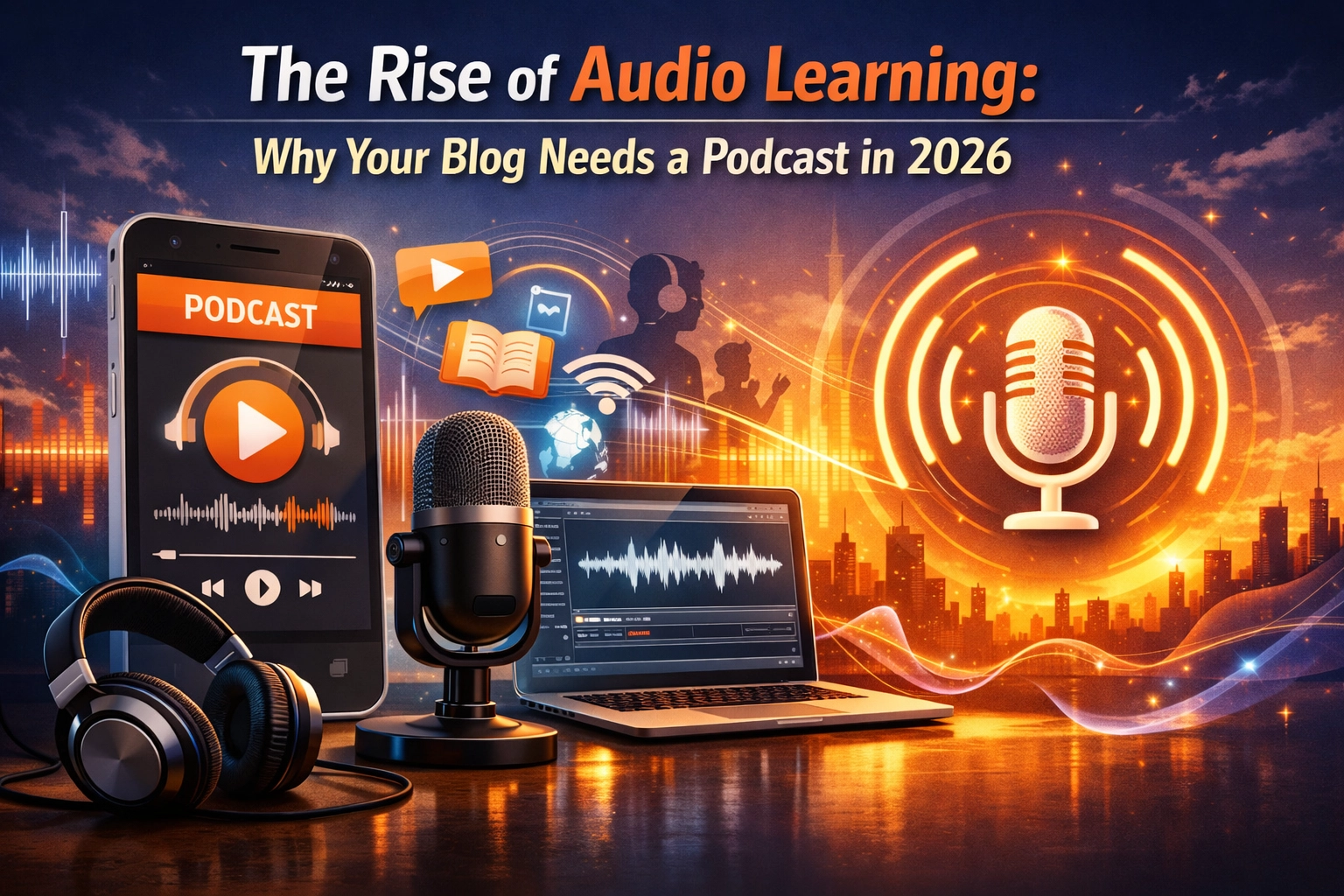
By 2026, the way we consume information has fundamentally shifted. We aren't just a "reading" society or a "watching" society anymore; we have become an "audio-first" society. If you’re still relying solely on written text to drive your blog’s growth, you’re essentially leaving more than half of your potential audience on the table.
The numbers don't lie. Global podcast listeners are projected to hit 619.2 million this year. In the United States alone, 55% of the population tunes in monthly. But this isn't just about "people liking podcasts." It’s about how audio learning has become the primary bridge between a busy lifestyle and the desire for self-improvement.
For blog owners and content creators, adding a podcast isn't a "nice-to-have" luxury anymore: it’s a core SEO strategy and the ultimate engagement tool. Here is why your blog needs an audio counterpart in 2026 and how you can leverage it to dominate your niche.
The "Eyes-Free" Economy: Why Reading Isn't Enough
The biggest limitation of a traditional blog post is that it requires 100% of the user’s visual attention. Your readers have to be sitting down, staring at a screen, and actively scrolling. In a world where screen fatigue is a real medical concern and people are constantly on the move, that’s a high barrier to entry.
Audio breaks that barrier. Audio learning thrives in the "in-between" moments: the morning commute, the gym session, the 20 minutes spent washing dishes, or the walk to the grocery store. By turning your blog content into a podcast, you are moving from a "destination" they have to visit to a "companion" that follows them throughout their day.
In 2026, 83% of podcast listeners spend more than nine hours a week with their headphones on. If your voice isn't in those headphones, your competitor’s voice will be.

Boosting Your SEO Through Audio Integration
Many creators mistakenly think that podcasts are bad for SEO because Google "can't crawl audio." That might have been true in 2018, but in 2026, the reality is the opposite. A podcast is one of the most powerful tools in your SEO arsenal for three specific reasons:
1. The Power of Transcripts and Long-Tail Keywords
When you host a podcast, you should always publish a full, high-quality transcript or a deeply detailed show-notes page on your blog. This provides Google with a massive amount of text-based content. Because spoken language is often more natural and conversational than written prose, these transcripts often rank for long-tail keywords and "question-based" queries that you might have missed in a standard blog post.
2. Audio Schema and Google Search Results
Search engines have become much better at indexing audio content. By using the correct "Podcast" schema markup on your website, your episodes can appear directly in Google Search results with a play button. This increases your digital real estate and improves your click-through rate (CTR).
3. Increased Dwell Time
Google tracks how long a user stays on your page. If a reader lands on your blog post and sees a 45-minute audio player at the top, and they decide to hit play while reading along or browsing your site, your "dwell time" skyrockets. High dwell time signals to Google that your content is valuable, which pushes your rankings higher.
The YouTube Pivot: Why Video Podcasting is Non-Negotiable
We can’t talk about podcasts in 2026 without talking about YouTube. One in three Americans now uses YouTube as their primary podcasting platform. YouTube has officially surpassed Spotify and Apple Podcasts in many demographics as the go-to spot for long-form audio-visual content.
By recording your podcast with a camera (a "vodcast"), you’re creating content that works for two massive search engines simultaneously. You get the audio for the traditional podcast feeds and the video for YouTube’s algorithm.
This creates a "flywheel effect." A user finds your video on YouTube, likes your expert insights, visits your blog to see the show notes, signs up for your newsletter, and becomes a loyal fan.
Building Human Connection in an AI-Saturated World
We are currently living through an explosion of AI-generated content. Blogs are being flooded with generic, AI-written articles that lack soul and personality. While AI is a great tool for research and structure, it struggles to replicate the nuance, emotion, and "vibe" of a human voice.
This is where your podcast becomes your greatest competitive advantage. When a reader hears your voice, hears you laugh, and hears the passion in your tone, they develop a level of trust that text alone can never achieve.
In 2026, "Expertise, Authoritativeness, and Trustworthiness" (E-A-T) are the gold standards for ranking. A podcast proves you are a real person with real expertise. It turns "users" into "fans." People don't buy from blogs; they buy from people they trust. Your voice is the fastest way to build that trust.
The Economics of Audio: Lower Costs and Higher Returns
One of the main reasons blog owners hesitated to start podcasts in the past was the cost and the technical "headache." In 2026, those excuses are gone. AI adoption has reduced podcast production costs by roughly 20%.
Tools now exist that can:
- Automatically remove "ums" and "ahs" from your audio.
- Generate studio-quality sound from a cheap laptop microphone.
- Create social media "audiograms" and short-form clips (TikToks/Reels) from your long-form episodes in seconds.
- Provide highly accurate ad-targeting, ensuring that your monetization efforts actually reach the right people.
Speaking of monetization, the ROI on podcasting is staggering. Research shows that 68% of listeners retain 80% or more of the ad content they hear in a podcast. Compare that to the 50% retention rate for TV ads or the even lower rates for banner ads on a website. Because the listener feels a personal connection to the host, they are far more likely to take action on a recommendation.

How to Integrate a Podcast into Your Existing Blog Strategy
You don't need to reinvent the wheel to start. In fact, the best way to start a podcast in 2026 is to look at your existing blog data.
- Identify Your Top-Performing Posts: Look at your analytics. Which 10 articles get the most traffic? Those are your first 10 podcast episodes.
- Repurpose, Don't Redo: You don't need to write a new script. Use the blog post as an outline. Expand on the points, share a personal story related to the topic, and answer common questions you’ve received in the comments section.
- Embed the Player Everywhere: Every blog post should have an embedded audio player at the top. Give your audience the choice: "Read the post or listen to the episode."
- Capture the "Micro-Content": Take a 60-second "gold nugget" from your podcast and embed it as a video or audio clip within the text of your blog. This breaks up long walls of text and keeps the user engaged.
| Benefit | Impact on Blog | Why it matters in 2026 |
|---|---|---|
| Multitasking | Higher reach | People consume content while doing other things. |
| YouTube Reach | New traffic source | YouTube is the #1 podcast platform now. |
| Trust Factor | Higher conversions | Voice creates a human bond that AI text can't. |
| Dwell Time | Better SEO | Longer page sessions lead to higher Google rankings. |
The Risk of Being Silent
The competition for attention is fiercer than it has ever been. In 2026, if your blog is just a collection of text, you are essentially whispering in a room where everyone else is using a megaphone.
Audio learning is not a trend; it is a permanent shift in human behavior. It is the most efficient way to learn, the most personal way to connect, and one of the most effective ways to boost your site’s SEO performance.
Start small. Grab a decent microphone, look at your best blog post, and hit record. Your audience is already listening: they’re just waiting for you to say something.
About the Author: Malibongwe Gcwabaza
Malibongwe Gcwabaza is the CEO of blog and youtube, a leading digital strategy firm helping creators and businesses navigate the intersection of content and technology. With over a decade of experience in the digital space, Malibongwe focuses on simple, actionable strategies that drive real engagement and sustainable growth. When he's not analyzing the latest SEO trends, he's exploring the future of decentralized content and AI integration.
About the Author