By 2026, the barrier between "the business side" and "the tech side" has effectively dissolved. If you are a manager today, you are no longer just overseeing people; you are overseeing a digital ecosystem. The rise of low-code automation has shifted the power of software creation from elite engineering teams to the hands of those who actually understand the business problems: the managers.
This isn't just about saving a few hours on data entry. We are looking at a fundamental shift in how enterprise value is created. According to 2025 industry benchmarks, organizations leveraging low-code platforms are deploying solutions 10x faster than those stuck in traditional development cycles. For a non-tech manager, mastering low-code is no longer an "extra credit" skill: it is a core competency for survival in a high-inflation, high-efficiency market.
The Architecture of Low-Code: What’s Under the Hood?
To lead a team effectively, you don’t need to know how to write Python or C++, but you do need to understand the architecture of how these systems talk to each other.
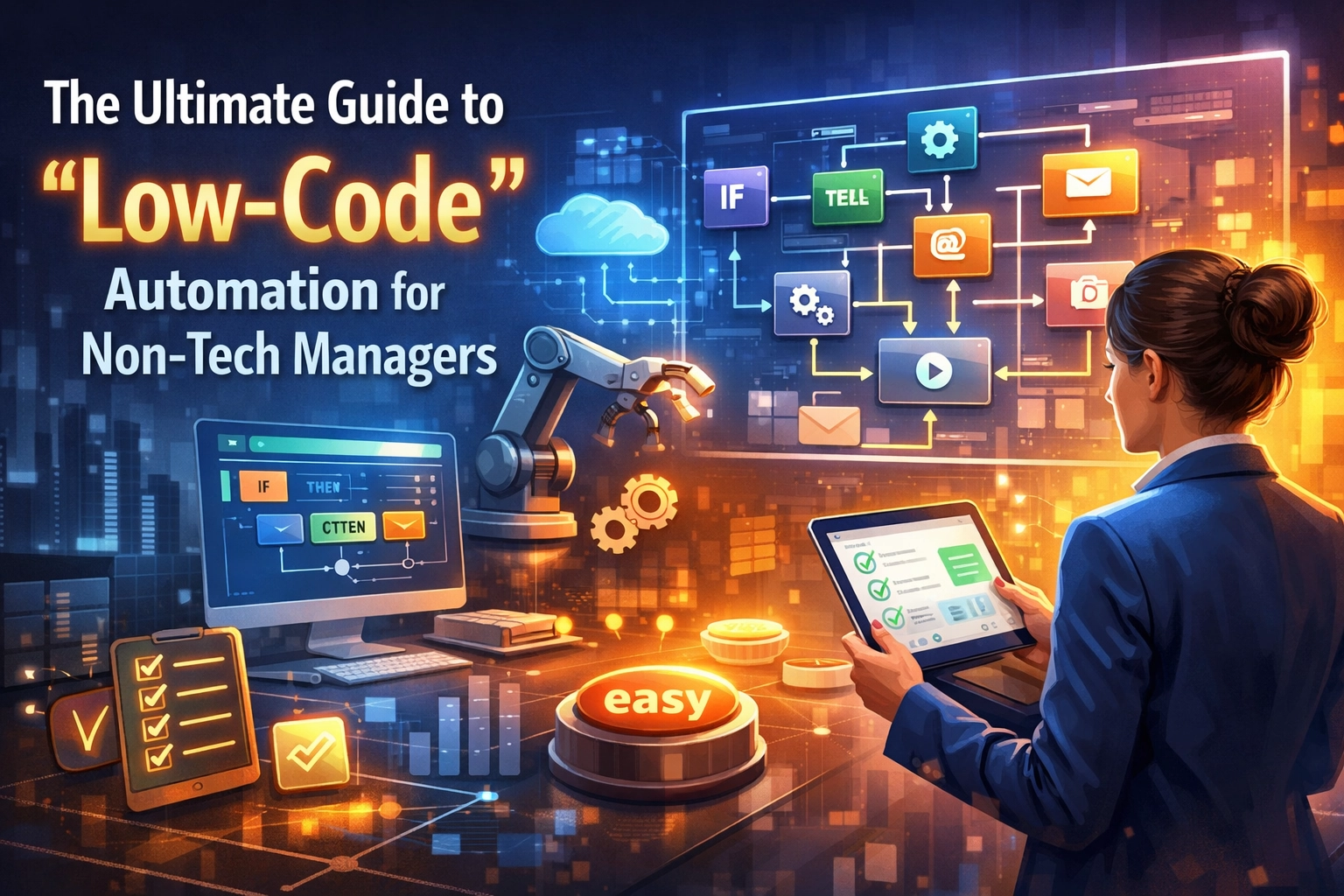
Low-code platforms operate on a visual abstraction layer. Instead of writing lines of syntax, you are interacting with "nodes" or "blocks" that represent logic.
- The Trigger: This is the "If." If a new lead signs up on the website…
- The Action: This is the "Then." Then, create a record in the CRM.
- The Logic Hook: This is the "Wait" or "Filter." If the lead has an annual revenue over $1M, alert the VP; otherwise, send a standard intro email.
By 2026, these platforms have integrated Agentic Workflows. Unlike the simple "Zapier" style automations of 2022, modern low-code tools use AI agents that can make autonomous decisions within the workflow. For example, an agent can "read" an incoming contract, compare it against your company's standard compliance checklist, and only flag the manager if it finds a discrepancy.

Why Low-Code is the High-CPC Skill of 2026
From a financial perspective, the ROI of low-code is staggering. Traditional software development is plagued by "Technical Debt" and high specialized salaries. A senior developer in 2026 often commands a salary that is prohibitive for small-to-medium business units.
Low-code solves this through Citizen Development. When a marketing manager builds their own lead-scoring app, the "Cost per Feature" drops by roughly 70%.
- Reduced Maintenance: The platform provider handles the security patches and API updates.
- Agility: In a 2026 market where consumer trends shift weekly, waiting six months for a custom-coded tool is a death sentence.
- Data Sovereignty: With the shift toward Sovereign Clouds, low-code tools now allow managers to keep data within specific geographic boundaries without needing a PhD in cloud architecture.
How to Implement Low-Code Without Breaking Your Systems
The biggest risk for a non-tech manager isn't the technology failing; it’s creating "Shadow IT." This happens when teams build a mess of uncoordinated automations that the IT department doesn't know about. To avoid this, follow this three-step framework:
1. The Inventory Audit
Before you drag a single block, map your process on a whiteboard (or a digital equivalent like Miro). If a process is broken manually, automating it will only make it break faster. Look for "high-volume, low-complexity" tasks. These are your gold mines for automation.
2. Choose the Right "Flavor" of Low-Code
Not all platforms are created equal.
- Internal Tools: If you need a dashboard for your team, look at platforms like Retool or Glide.
- Process Automation: For moving data between apps, look at Make or the updated Power Automate.
- AI-First Orchestration: If you need the system to "think," tools like LangChain or specialized agent builders are becoming the standard for managers in 2026.
3. Establish the "Human-in-the-Loop" (HITL)
Never automate a client-facing or high-stakes financial process 100%. In 2026, the most successful managers use "Human-in-the-Loop" design. The AI/Automation does 90% of the work, but a human must click "Approve" before the final action is taken. This mitigates the risk of "AI hallucinations" or logic errors that could damage your brand.

Case Study: The $0 Developer Strategy
Let’s look at a 2026 real-world scenario. A mid-sized logistics firm was struggling with "subscription bloat" and manual invoice matching. Traditionally, they would hire a software firm for $50,000 to build a custom solution.
Instead, the Operations Manager used a low-code platform to:
- Ingest: Automatically pull invoices from a dedicated Gmail folder.
- OCR: Use an integrated AI module to "read" the PDF text.
- Validate: Match the invoice amount against their internal database.
- Pay: Trigger a payment via a Smart Contract if the data matched perfectly.
The total cost? A $50/month subscription and 12 hours of the manager’s time. The "Time to Value" was two weeks instead of six months.
Overcoming the "Technical Intimidation" Barrier
The most common pushback from managers is: "I'm just not a tech person."
In 2026, "being a tech person" just means being a logical thinker. If you can explain a process to a new hire, you can build a low-code automation. The rise of Generative Engine Optimization (GEO) means that most low-code platforms now have a "Chat-to-Build" feature. You simply type: "I want a system that notifies me on Slack whenever a customer leaves a negative review and then drafts a polite apology email for me to review."
The platform generates the logic. Your job as a manager is to audit that logic for business alignment.

Security and Ethics: The Manager’s Responsibility
With great power comes the responsibility of data privacy. As a non-tech manager, you must ensure your low-code solutions are GDPR (or the 2026 equivalent) compliant.
- Encryption: Ensure the platform uses end-to-end encryption.
- Access Control: Just because you can build an app that sees everyone's salary doesn't mean you should. Use the "Principle of Least Privilege": give the automation only the data it absolutely needs.
- Deepfake Awareness: In 2026, identity security is paramount. Ensure your automations have safeguards against deepfake-injected data or spoofed identities.
The Verdict: Your Career in the Age of Automation
The managers who will thrive in the next five years are those who view themselves as Systems Architects. By leveraging low-code, you free yourself from the "managerial overhead" of checking boxes and chasing status updates. You transition into a role where you are designing workflows that work while you sleep.
Low-code isn't just a tool; it's a career insurance policy. In an era where AI can handle basic administrative management, the ability to build and maintain the systems that govern that AI is the most valuable skill you can possess.
About the Author: Malibongwe Gcwabaza
Malibongwe Gcwabaza is the CEO of blog and youtube, a forward-thinking media company specializing in the intersection of AI, automation, and modern career development. With over a decade of experience in digital transformation, Malibongwe focuses on empowering non-technical leaders to harness "frontier tech" to drive operational excellence. Under his leadership, blog and youtube has become a primary resource for professionals navigating the 2026 economy, emphasizing simple, actionable insights over complex jargon. When he isn't architecting new business workflows, he explores the impact of sovereign cloud technology on global data privacy.
About the Author