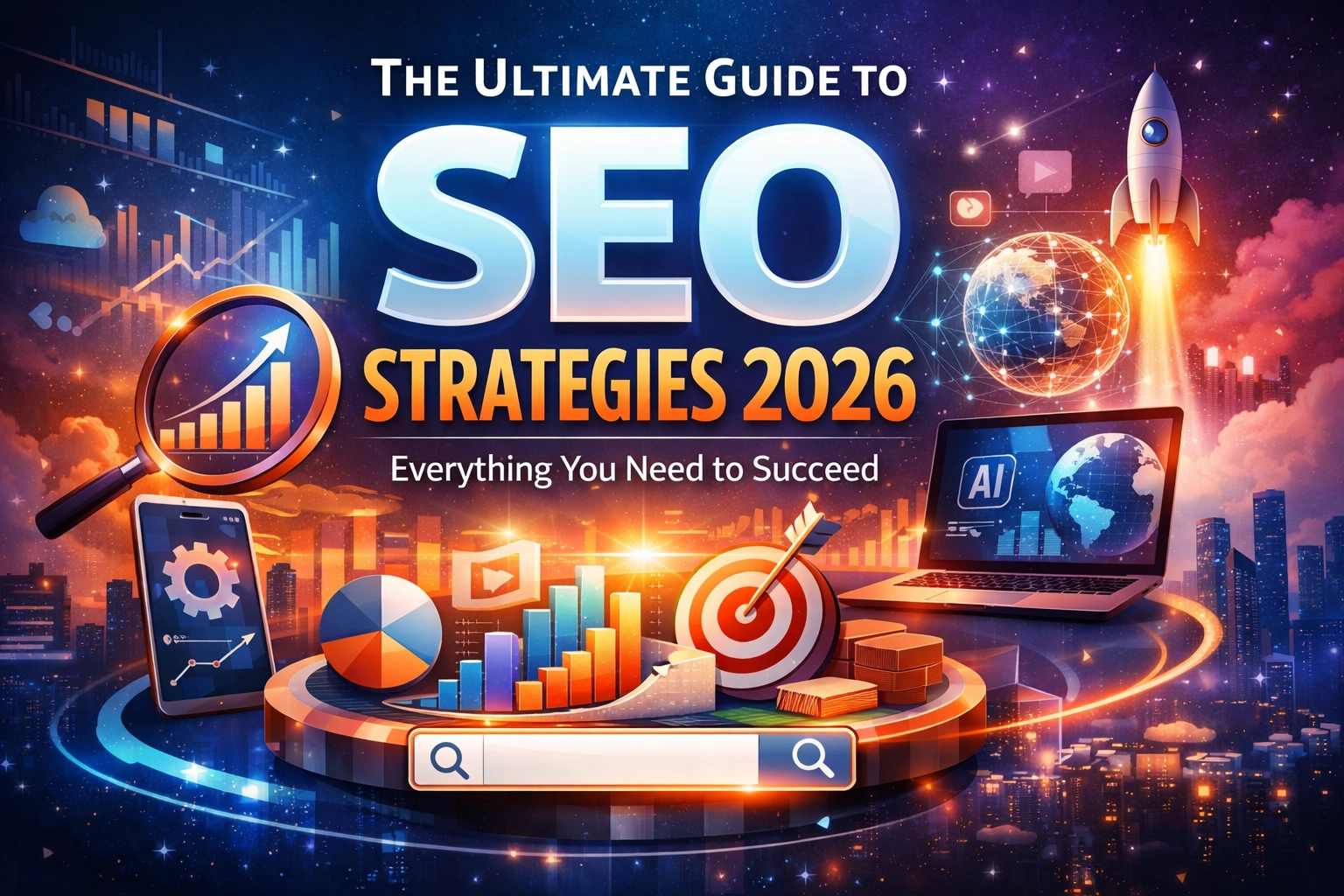
The days of "tricking" an algorithm with keyword stuffing and backlink schemes are officially over. If you’re still looking at SEO as a way to "game" Google, you’re already behind. In 2026, SEO isn't just about ranking #1 on a list of blue links; it’s about becoming the definitive source that AI models, voice assistants, and social platforms point to when a user has a problem.
The search landscape has fragmented. While Google remains a powerhouse, the way people find information has shifted toward Search Generative Experience (SGE), specialized AI agents, and visual-first platforms like TikTok and YouTube. To win in 2026, your SEO strategy needs to be as dynamic as the AI models crawling your site.
The Era of Search Generative Experience (SGE)
By now, SGE isn't a "new feature": it’s the standard. When someone searches for "how to scale a small business in 2026," they aren't always clicking through to a website. They’re reading an AI-generated summary right at the top of the page.
To succeed here, your content needs to be "AI-ready." This doesn't mean writing for robots; it means writing content that is so structured and authoritative that an AI must cite you to be accurate. We call this "Information Gain." If your article just repeats what 10 other blogs say, the AI will summarize the general consensus and ignore you. If you provide a unique dataset, a proprietary framework, or a first-hand case study, the AI is forced to credit you as the source of that specific insight.
How to Optimize for AI Citations
- Direct Answers: Start your sections with a clear, concise answer to the primary question.
- Structured Data: Use advanced Schema markup to tell search engines exactly what your data represents.
- Unique Perspectives: Include "According to our internal data" or "In our experience testing X for six months." This is the "Experience" in E-E-A-T that AI cannot replicate.

E-E-A-T: The Only Shield Against AI Spams
With the explosion of AI-generated content, the internet is flooded with "generic" information. Google’s response has been to double down on E-E-A-T (Experience, Expertise, Authoritativeness, and Trustworthiness).
In 2026, "Experience" is the most important letter in that acronym. Anyone can ask an AI to write a guide on "how to bake a cake." But only someone who has actually burnt their hands on an oven can describe the specific smell of a perfectly done sponge or the tactile resistance of over-folded batter.
Building Radical Trust
To prove your E-E-A-T, you need to move beyond just writing. You need a digital footprint that proves you are a real person with real skills.
- Author Bios: Don't just list a name. Link to a LinkedIn profile, a portfolio, or a YouTube channel.
- First-Person Narrative: Use "I" and "We." Share your failures as much as your successes.
- Case Studies: Real-world applications of your advice are the gold standard for proving expertise.
The Rise of Voice and Conversational Search
We’ve moved past the era of "near me" searches. In 2026, people are having full-blown conversations with their devices. They aren't typing "best running shoes"; they’re asking their glasses or their car, "What are the most durable trail running shoes for someone with wide feet and a $150 budget?"
This shift toward long-tail, conversational queries means your keyword strategy needs to focus on intent, not just phrases.
Conversational SEO Tactics
- FAQ Sections: Use natural language questions as your H3 tags.
- Natural Language Processing (NLP): Write the way you speak. If your blog sounds like a textbook, it won't match the conversational tone of voice search results.
- Bullet Points and Lists: Voice assistants love structured data because it's easy to read aloud.

Video SEO: The YouTube and TikTok Factor
In 2026, a "search result" is just as likely to be a 60-second video as it is a 1,500-word article. Google has fully integrated YouTube Shorts and TikToks into the mobile SERPs. If you aren't producing video content, you’re invisible to a massive segment of the population.
YouTube is now the world’s second-largest search engine, and its integration with Google’s main search is tighter than ever. A well-optimized video can often outrank a high-authority blog post for "how-to" queries.
Optimizing for Video Discovery
- Chapters and Timestamps: Give Google the roadmap of your video so it can surface "Key Moments" directly in search results.
- Closed Captions: Don't rely on auto-generated captions. Upload your own to ensure the keywords are captured accurately by the crawlers.
- Vertical Strategy: Create content specifically for vertical formats (Shorts/Reels) to capture the mobile-first "discovery" traffic.
Branded Search: The Ultimate SEO Hack
One of the most overlooked SEO strategies for 2026 is building brand salience. If people search for your brand name specifically, Google views you as a category leader.
If people search for "SEO tips," you’re competing with millions of pages. If they search for "LearnRise SEO tips," you’ve already won. Building a brand that people ask for by name is the most sustainable way to survive algorithm updates.
How to Drive Branded Searches
- Multi-Channel Presence: Be everywhere your audience is: podcasts, newsletters, and social media.
- Community Building: Engaging with your audience in comments and forums makes your brand memorable.
- Exclusive Content: Give people a reason to look for your specific take on a topic.

Technical SEO in a Post-Mobile World
Technical SEO is no longer about just having a fast site; it’s about having a "travel-ready" site. Your content needs to be easily parsed by AI crawlers, screen readers, and various device types.
Core Web Vitals are still the baseline. If your site takes more than two seconds to load on a 5G connection, you’re losing users and ranking points. But in 2026, we also look at "Interaction to Next Paint" (INP) as a critical metric for how responsive your site feels to the touch.
2026 Technical Checklist
| Feature | Importance | Action Item |
|---|---|---|
| Mobile-First Indexing | Critical | Ensure your mobile site has 100% parity with desktop content. |
| Site Speed (INP) | High | Minimize JavaScript execution time to make the site feel "snappy." |
| Schema Markup | Essential | Use 'Speakable' and 'Article' schema to help AI and Voice engines. |
| Accessibility | High | Use high-contrast colors and descriptive alt-text for all images. |
Topic Clusters vs. Individual Keywords
The old way of SEO was to create one page for "SEO strategy" and another for "SEO tips." In 2026, Google understands context better than ever. You need to build "Topic Clusters."
A topic cluster consists of a "Pillar Page" (like this one) that covers a broad topic in depth, which then links to "Cluster Content" that dives into specific sub-topics. This creates a web of internal links that signals to Google that you are an authority on the entire subject, not just a lucky guesser on a single keyword.
Creating a Cluster
- Identify your Pillar: Choose a broad, high-volume term (e.g., "Digital Marketing").
- Map Sub-topics: Brainstorm 10-20 specific questions or niches related to that pillar (e.g., "Email segmentation," "PPC bidding," "AI copywriting").
- Interlink Relentlessly: Every cluster piece should link back to the pillar, and the pillar should link to every cluster piece.
Measuring Success: Beyond the Rank
In the past, we measured success by where we ranked for a specific keyword. Today, that’s a vanity metric. Because search results are now personalized and dynamic (thanks to SGE), your rank might be #1 for me and #4 for you.
In 2026, we measure Pixel Prominence and AI Citations.
- Pixel Prominence: How much of the screen does your brand occupy when a query is made? This includes your organic link, your video, and your presence in the AI summary.
- AI Citations: How many times is your brand mentioned as a source in SGE or ChatGPT-style answers?
- Conversion Rate: Ultimately, 100 high-intent visitors are worth more than 10,000 "window shoppers."

Final Thoughts: The Human Advantage
As we look toward the rest of 2026, the biggest mistake you can make is trying to compete with AI on volume. AI can write 1,000 articles a minute; you can’t. But AI cannot go out into the world, run an experiment, talk to a customer, or have a unique opinion.
The "Ultimate SEO Strategy" for 2026 is simple: Be more human. Use AI to do the heavy lifting of research and formatting, but put your own soul into the final product. Provide the data that the AI wants to cite, the personality that the voice assistant wants to emulate, and the authority that the user is looking for.
SEO isn't dead; it just grew up. It’s time for your strategy to do the same.
About the Author: Malibongwe Gcwabaza
Malibongwe Gcwabaza is the CEO of LearnRise and a veteran in the digital marketing space. With over a decade of experience navigating the shifts from desktop search to the AI-driven landscape of 2026, Malibongwe focuses on helping small businesses build sustainable, brand-first growth strategies. When he's not dissecting the latest Google algorithm update, he's exploring the intersection of technology and human learning to make education more accessible for everyone.
About the Author