For a long time, content marketing felt like a numbers game. You found a keyword with 5,000 monthly searches, sprinkled it into a 1,000-word article, and prayed to the Google gods for a spot on page one. If you were a small business, you were essentially trying to out-shout giants with massive budgets.
But it’s 2026, and the game has fundamentally changed. The "shouting match" is over. Search engines have evolved from simple library catalogs into sophisticated AI-driven assistants that don’t just read your words, they understand your customer's state of mind.
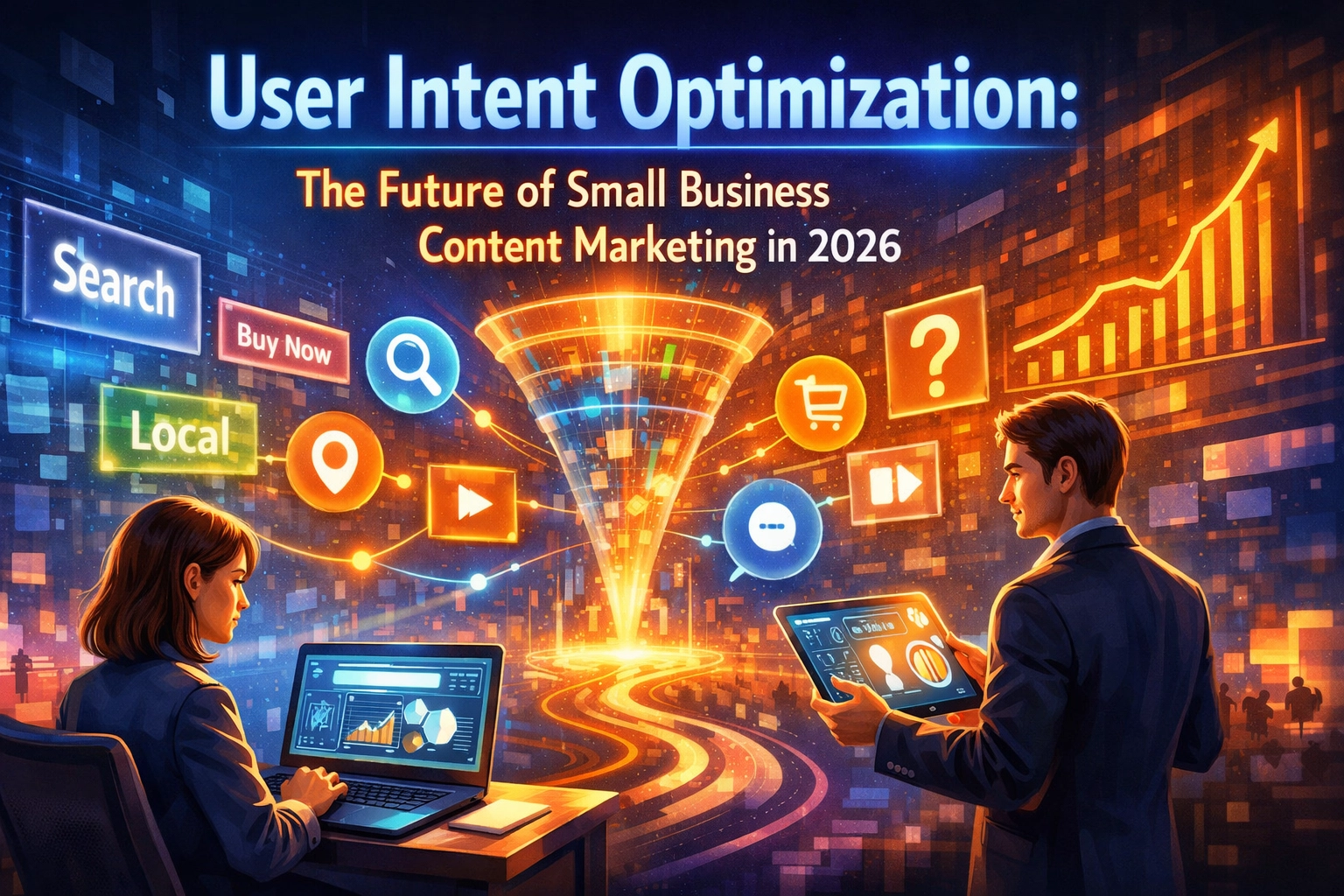
Today, success isn't about matching keywords; it’s about User Intent Optimization (UIO). If you’re still obsessed with keyword density, you’re essentially bringing a knife to a laser-tag fight. Let's dive into why intent is the only metric that actually matters for your bottom line this year.
The Death of the Keyword-First Strategy
In 2026, roughly 80% of search queries are conversational. People aren't typing "best plumbing service" anymore; they’re asking their AI glasses or phones, "Hey, who can fix a leaky pipe in Sandton before my dinner party at 6 PM?"
Keywords are just the "what." Intent is the "why."
Old-school SEO focused on the "what." User Intent Optimization focuses on the context: the location, the time of day, the search history, and the specific stage of the buyer’s journey. For a small business, this is actually the best news you’ve heard in years. Why? Because you don't need to produce 100 generic articles a month to compete. You just need to produce five articles that perfectly answer the "why."

Why Keywords Alone Fail in 2026
- Ambiguity: A keyword like "marketing" could mean someone wants a job, a definition, or a service. AI now prioritizes content that solves a specific problem rather than covering a broad term.
- AI Summaries: Search engines now provide "zero-click" answers. If your content is just a list of definitions, the AI will scrape it, show it on the search page, and the user will never visit your site. You need to provide depth that an AI summary can’t replace.
- Voice and Visual Search: People search with images and natural speech. These don't follow "keyword" rules; they follow human intent rules.
Understanding the Four Pillars of Intent
To win at content marketing in 2026, you have to categorize every piece of content you create into one of these four buckets. If a post doesn't clearly serve one of these, don't publish it.
1. Informational Intent (The "How-To" and "Why")
These users are looking for knowledge. They aren't ready to buy yet, but they are looking for a guide. In 2026, the key here is Topical Authority. You shouldn't just answer one question; you should be the go-to resource for the entire subject.
- Small Business Example: A local nursery writing "The Ultimate Guide to Keeping Succulents Alive in High-Humidity Apartments."
2. Navigational Intent (The "Find Me")
The user knows who you are; they just need to find a specific page. This is where your technical SEO and site structure come in. Ensure your "Contact Us," "Pricing," and "Service Area" pages are clear and easy for AI to crawl.
3. Transactional Intent (The "Buy Now")
This is the "shut up and take my money" stage. These users are searching for "price of X," "X near me," or "buy X online." Your content here needs to be frictionless. No fluff: just benefits, social proof, and a clear call to action (CTA).
4. Commercial Investigation (The "Which One is Better?")
This is the sweet spot for small businesses. Users are comparing options. Content like "Product A vs. Product B" or "Top 10 Services in [City]" performs incredibly well because it captures users right before they pull out their credit cards.

Enter the Era of "Micro-Intents"
Standard intent categories are great, but 2026 has introduced Micro-Intents. These are granular variations of search intent based on real-time context.
Let's say you own a boutique fitness studio.
- Intent: "Yoga classes."
- Micro-Intent A (8:00 AM): "Yoga classes near me starting now." (Immediate action, navigational/transactional).
- Micro-Intent B (8:00 PM): "Benefits of morning vs. evening yoga." (Informational, research-based).
Small businesses that tailor their content to these micro-moments see a 30% higher conversion rate. Instead of one giant "Yoga" page, you have a "Morning Energy Flow" page and an "Evening Stress Relief" page. You are meeting the user exactly where their head is at that specific moment.
Quality Over Volume: The Traffic Quality Paradox
Here is a pill that’s hard to swallow for some: Your total website traffic might go down in 2026.
Wait, don't close the tab! This is a good thing.
Because of AI-generated answers in search results, "junk" traffic (people looking for quick definitions) is disappearing. What’s left is High-Intent Traffic. These are people who actually clicked through to your site because the AI summary wasn't enough: they need your expertise, your specific service, or your unique perspective.
The result? You might have 500 visitors a month instead of 2,000, but those 500 are 5x more likely to buy. For a small business, this is a dream scenario. You spend less time managing "window shoppers" and more time closing leads.

Building Topical Authority via Content Clusters
In 2026, Google doesn't rank "pages"; it ranks "entities" it trusts. To be seen as a trusted entity, you need a content cluster.
Think of it like this:
- The Pillar: A massive, 3,000-word "Ultimate Guide" to your main service.
- The Spokes: 10-15 smaller, 1,200-word articles that deep-dive into specific sub-topics or micro-intents related to that pillar.
- The Internal Links: Every "spoke" links back to the "pillar" and vice versa.
This structure tells search engines, "I’m not just a guy with a blog; I am an expert who understands every nook and cranny of this industry." This "Expertise, Experience, Authoritativeness, and Trustworthiness" (E-E-A-T) is the only thing that protects your rankings from being replaced by generic AI content.
How to AI-Proof Your Content
You can't beat AI at being a library, so beat it at being a human. AI is great at facts, but it’s terrible at opinion, nuance, and personal experience.
To optimize for intent in 2026, your content must include:
- Case Studies: "How we helped a client in Pretoria double their revenue" is something AI can't fake.
- Original Data: Conduct a poll or share your own business insights.
- Strong Opinions: Don't be "neutral." If you think a common industry practice is garbage, say so. Intent-driven users are looking for leaders, not parrots.
- Structured Data: Use Schema markup to help search engines understand exactly what your content is about. This helps you show up in those "AI Overviews" as the cited source.

Practical Steps for Your 2026 Strategy
Ready to overhaul your content? Follow this checklist:
- Audit Your Existing Content: Look at your top-performing pages. Are they actually answering the user's intent, or are they just ranking for a lucky keyword? If the bounce rate is high, you’re failing the intent test.
- Map Keywords to Intent Stages: Don't just list keywords. Assign each one to "Informational," "Transactional," etc.
- Optimize for the "Zero-Click": Write clear, punchy summaries at the start of your posts. If Google uses your summary for an AI snippet, you get the brand credit and the "source" link, which builds massive trust.
- Focus on Conversational Long-Tail Phrases: Instead of "HVAC repair," optimize for "Why is my AC making a clicking noise at night?"
- Refresh Regularly: Intent changes. What people wanted from a "home office setup" in 2021 is very different from what they want in 2026. Keep your high-intent pages updated.
Final Thoughts: The Human Advantage
The future of small business marketing isn't about out-coding the algorithm. It’s about being more human than the competition. While big corporations use AI to churn out millions of average pages, you can use your deep understanding of your customers to create content that actually helps them.
User Intent Optimization is just a fancy way of saying "Give people what they actually need." Do that consistently, with authority and a bit of personality, and 2026 will be your most profitable year yet.
About the Author: Malibongwe Gcwabaza
Malibongwe Gcwabaza is the CEO of blog and youtube, a forward-thinking digital agency dedicated to helping small businesses navigate the complex world of modern content marketing. With over a decade of experience in SEO and digital strategy, Malibongwe focuses on simplifying the technical to help brands find their authentic voice and connect with their audience in a meaningful way. When he’s not dissecting the latest search algorithm updates, he’s passionate about empowering entrepreneurs to leverage video and written content for long-term growth.
About the Author