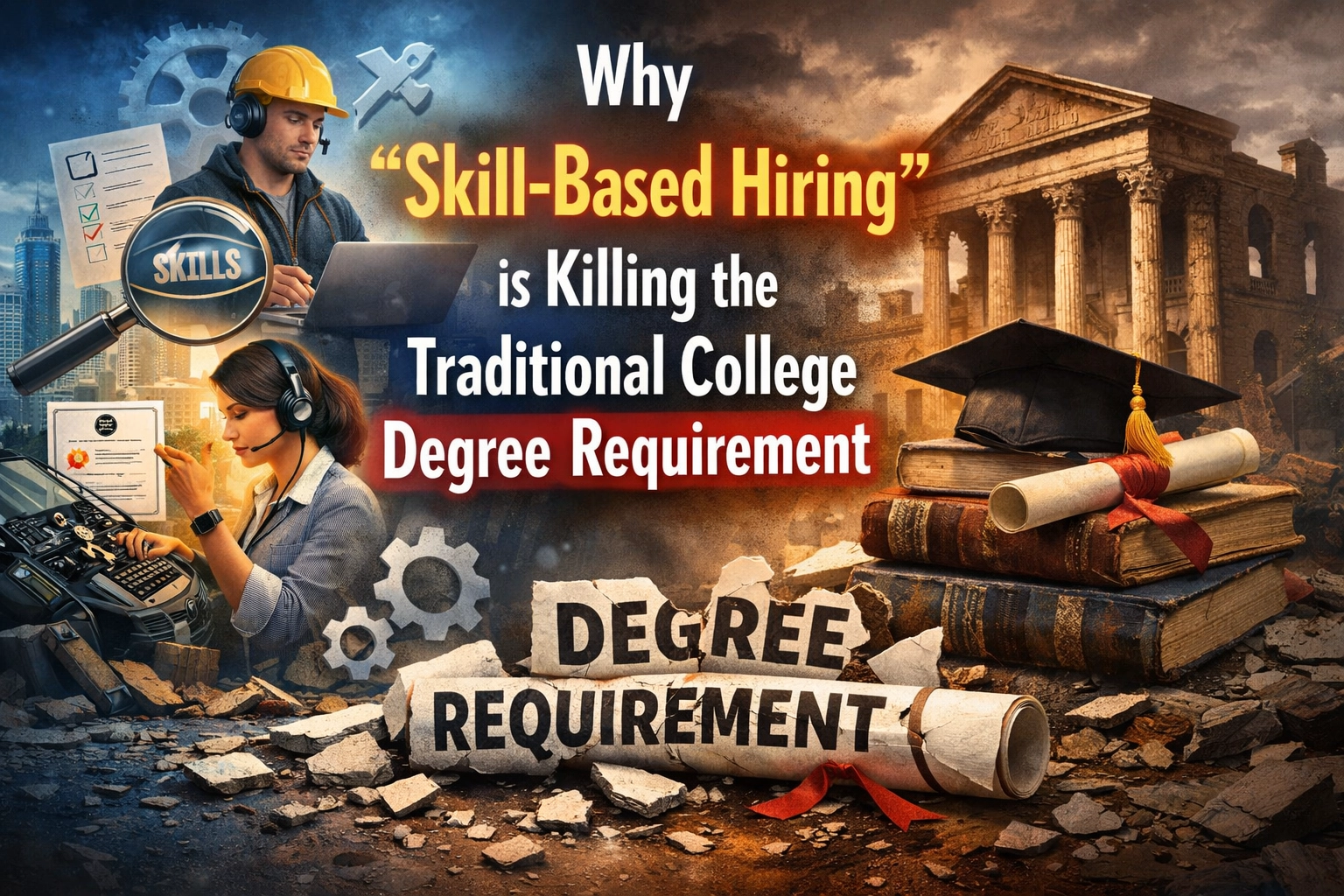
For decades, the bachelor’s degree was the ultimate gatekeeper. It was the "HR filter" that automatically discarded millions of capable candidates before a human being even looked at their resume. But as we move through 2026, that filter is being replaced by something far more precise: verifiable skill data.
The shift isn't just a trend; it's a structural realignment of the global economy. Companies like Google, IBM, and even traditional financial giants have realized that a four-year degree in English Literature or even General Business doesn't guarantee a candidate knows how to manage a modern tech stack, interpret real-time data analytics, or navigate AI-augmented workflows.
Today, "Proof of Work" has officially dethroned "Proof of Pedigree."
The Failure of the Degree as a Proxy
The primary reason for this shift is that degrees have become a poor proxy for actual job performance. In a 2024 Harvard Business School study, researchers found that degree-based hiring often led to "credential inflation," where companies required degrees for roles that didn't actually need them. This resulted in higher turnover and lower engagement.
By 2026, the data is even more stark. Internal audits across Fortune 500 companies show that 94% of skills-based hires outperform those chosen solely based on their educational background.
Why? Because a degree is a measure of persistence and institutional compliance, whereas a skill assessment is a measure of immediate capability. A candidate might spend four years studying "Marketing Theory" but never once touch a Meta Ads Manager or a HubSpot CRM. Conversely, a self-taught specialist with three high-level certifications and a portfolio of successful campaigns can deliver ROI on Day 1.
Expanding the Talent Pool by 10x
One of the most significant advantages of skill-based hiring is the sheer volume of talent it unlocks. Currently, roughly two-thirds of the adult population in the U.S. lacks a four-year college degree. By sticking to traditional hiring practices, companies were effectively ignoring 60-70% of the workforce.
When you remove the degree requirement, the talent pool expands by as much as 10 times. This is particularly crucial in the 2026 labor market, where specialized technical roles: like Prompt Engineers, AI Ethics Officers, and Cybersecurity Analysts: are in high demand. These are fields where the technology moves faster than a university curriculum can be updated. If you waited for a four-year degree to catch up to the latest generative AI developments, the knowledge would be obsolete by graduation.
The Rise of "Stackable" Credentials and Micro-Learning
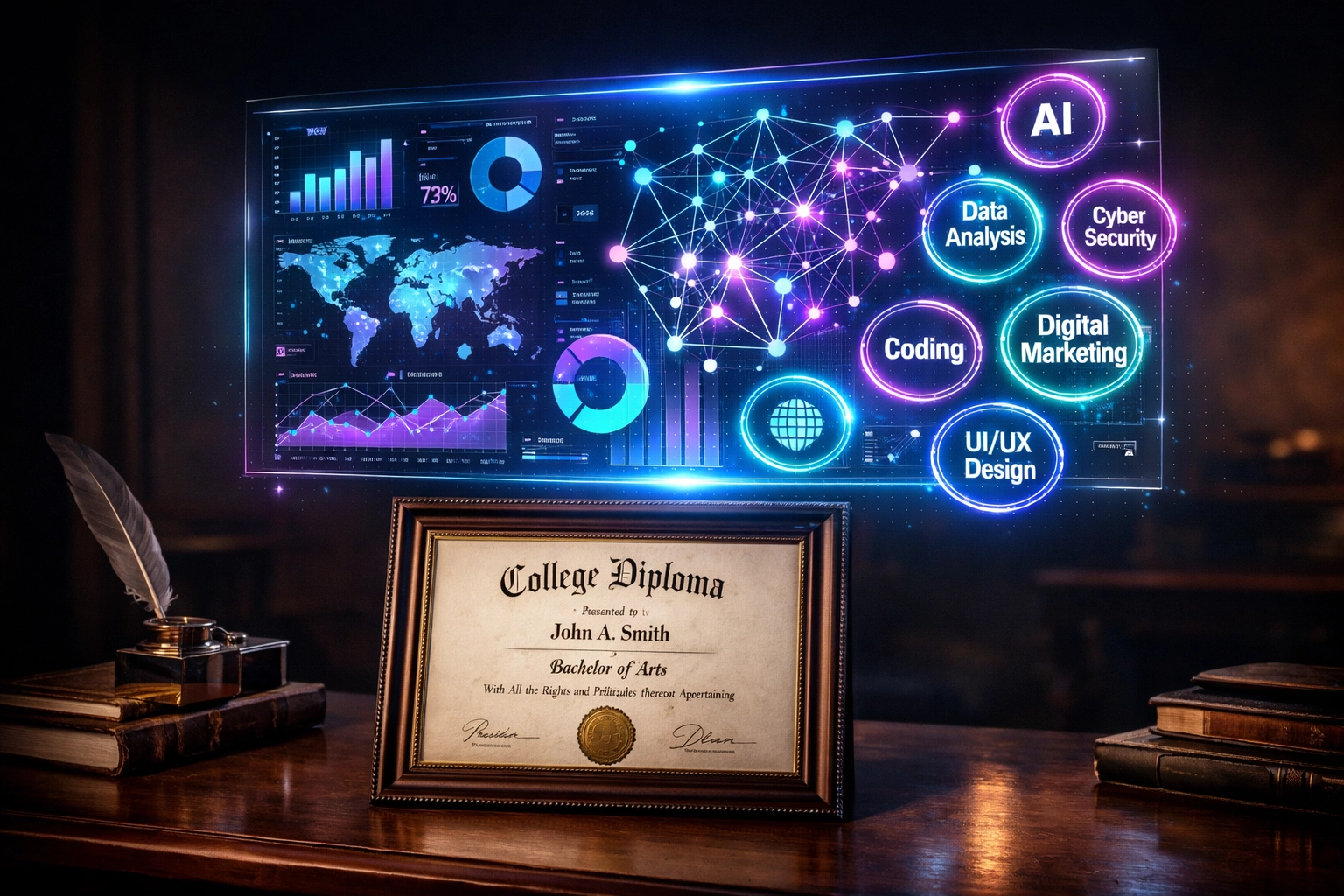
In place of the traditional degree, we are seeing the rise of "stackable" credentials. These are modular, verifiable bits of education that prove a specific competency.
- Industry Certifications: Google, AWS, and Microsoft have created their own "degrees" that are often more respected in technical circles than an Ivy League diploma.
- Nano-Degrees: Intensive, 3-to-6-month programs focused on a singular high-value skill (e.g., Data Visualization or Blockchain Architecture).
- Verifiable Portfolios: For creative and technical roles, platforms like GitHub (for code) and Behance (for design) serve as the "real" resume.
In 2026, recruiters are using AI-driven tools to scrape these platforms, looking for candidates who exhibit "High-Velocity Learning": the ability to master new tools quickly. This trait is far more valuable than a static degree earned a decade ago.

Technical Assessment: The New Interview
The interview process itself has changed. Instead of "Where do you see yourself in five years?" candidates are now facing technical "sandboxes."
A candidate applying for a Senior Developer role might be given an hour to debug a proprietary codebase in a simulated environment. A marketing candidate might be asked to draft a multi-channel strategy based on a live data set.
This move toward objective assessment removes human bias and focuses entirely on output. It’s no longer about whether the hiring manager likes the "vibe" of your university; it's about whether your code runs and your strategies convert.
The Economic Impact: ROI for Employers
For businesses, the shift to skill-based hiring is a matter of the bottom line. Degree-based hiring is expensive. Graduates often demand higher starting salaries due to student debt, yet they frequently require 6-12 months of on-the-job training to become "operationally fluent."
In contrast, skills-based hiring allows for:
- Faster Time-to-Productivity: Hires already possess the specific tool proficiency required.
- Lower Turnover: When a candidate is hired for what they can do rather than what they know, there is usually a better fit between the individual and the daily tasks of the role.
- Reduced Recruitment Costs: By expanding the pool and using automated skill testing, companies spend less time searching for the "perfect" pedigree and more time evaluating actual talent.

Is the Degree Dead?
Not quite, but its role has changed. In 2026, a degree is increasingly seen as a "foundational" layer: proof of basic literacy, social development, and critical thinking. It is no longer the "vocational" gold standard.
We are entering an era of Hybrid Hiring, where a bachelor’s degree might be "preferred," but a proven track record of skills is "required." For highly regulated fields like medicine or civil engineering, degrees remain mandatory. But for the vast majority of the "Knowledge Economy," the walls are coming down.
Strategic Advice for the 2026 Job Seeker
If you want to stay competitive in this new market, you need to stop focusing on your "Education" section and start focusing on your "Capabilities" section.
- Build a Public Portfolio: Whether it’s code, writing, or strategy decks, make your work searchable.
- Invest in Micro-Certifications: Keep your skills fresh. An AI certification from 2024 is already ancient history; get the 2026 version.
- Focus on "Hard" Tools: Be able to say "I am an expert in [Specific Software]" rather than "I am good at communications."
- Leverage "Proof of Work" Platforms: Use LinkedIn to showcase specific projects, not just job titles.
The "Paper Ceiling" is shattering. In the 2026 economy, the world doesn't care where you went to school. It only cares about what you can build, solve, and create.
About the Author: Malibongwe Gcwabaza
Malibongwe Gcwabaza is the CEO of blog and youtube, a leading digital media firm dedicated to tracking the intersection of technology, career evolution, and the future of work. With over a decade of experience in strategic talent acquisition and digital entrepreneurship, Malibongwe provides data-driven insights to help professionals navigate the rapidly shifting 2026 job market. His focus is on democratizing access to high-paying careers through skill-based education and AI-augmented productivity.
About the Author